

September 25, 2025
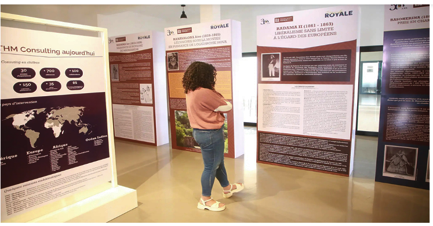
It was half-past two on Tuesday when the guided tour began. In the exhibition hall of the Cité des Cultures in Antaninarenina, mosaics of graphics and archival pieces on the economic history of the Big Island were displayed. With journalists and the few students present, the guides were busy explaining the ins and outs of the exhibition.
The first panels of the exhibition reveal a dynamic economy, integrated into the Indian Ocean trade networks. Recent research highlights the lively commercial interactions between the island’s first populations and the East African coast and the Gulf countries. « Since the 13th century, the port of Manilika, located on Madagascar’s northwest coast, has emerged as a dynamic center for maritime trade, » the panels indicate, emphasizing the importance of these exchanges.
Commercial activities, focused on the import of pearls and ceramics and the export of iron and chloroschist objects, contributed to the creation of powerful trading networks. Madagascar, even in ancient times, was a place of commercial effervescence, as attested by Arab-Persian texts mentioning contacts with the Persian Gulf.
Reinforced Exchanges
The 19th century was marked by the Europeanization of the economy, with reinforced trade in the eastern maritime province of the kingdom. This period intensified relations with Western powers, notably Great Britain and France (for certain regions not conquered by Radama I). This period occurred within a context of rivalry between these two powers over the Indian Ocean.
The French colonial settlement led to the development of infrastructures and favored export crops, while integrating Madagascar into world markets; however, this came at the expense of local industrialization and economic autonomy. After independence in 1960, Madagascar attempted to diversify its economy and strengthen its autonomy, but political instability and economic shocks hindered these advances, leading to a slowdown in growth. Since the end of the First Republic, the Big Island has suffered cyclical crises, weakening its industrial base and development, despite considerable assets.
Organized by FTHM Consulting in partnership with the University of Antananarivo, this exhibition will run until October 31. It is aimed at students, the general public, but also researchers and investors who wish to learn about the country’s economic history.
Alain Pierre Bernard, a consultant at FTHM Consulting, highlights the importance of this exhibition. « Through this exhibition, our objective is twofold: to offer everyone a unique opportunity to better understand the roots of our current challenges and to show that governance and lessons from the past are essential levers for building a fairer and more prosperous future, » he declared at the opening of the exhibition, which will continue until October 31.
Itamara Otton